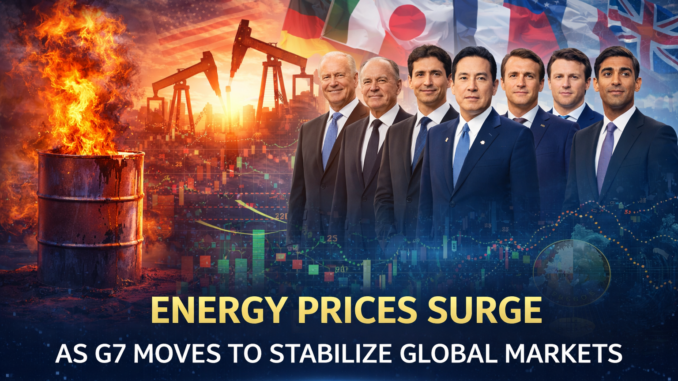
Energy prices became one of the biggest economic stories this week as global markets reacted to supply disruption, rising oil costs, and growing inflation concerns. The sharp increase in energy prices put pressure on stocks, businesses, and consumers, while governments and international institutions moved quickly to calm markets. Among the most important developments was the G7’s statement that it was ready to take all necessary steps to support energy market stability.
The reason energy prices matter so much is simple. Oil and fuel costs affect transportation, manufacturing, electricity generation, and daily household spending. When oil prices rise sharply, the impact spreads across the economy. Businesses face higher input costs, shipping becomes more expensive, and inflation can accelerate as those costs are passed on to consumers. This week, that chain reaction became a major concern for global investors.
Much of the pressure came from Middle East supply disruption. The International Energy Agency warned that oil supply problems are expected to worsen in April, with losses likely to be much larger than they were in March. Reuters reported that more than 12 million barrels of oil had already been lost and that shortages in key fuels such as diesel and jet fuel were beginning to affect Asia and were expected to hit Europe as well.
That warning helps explain why financial markets were so nervous earlier in the week. Rising energy costs do not only hurt oil-dependent industries. They also create fears of inflation, slower growth, and tighter financial conditions. When markets believe inflation may stay high, investors begin to worry that central banks will have less room to support growth with lower interest rates. This can weaken sentiment across stocks, bonds, and currencies.
The G7 response was important because it signaled that the world’s leading advanced economies are taking the situation seriously. Finance leaders from the United States, Canada, Japan, Britain, France, Germany, and Italy said they were prepared to take all measures needed to maintain energy market stability. They also backed the International Energy Agency’s release of 400 million barrels from strategic reserves and called for reliable energy supplies without unjustified export restrictions.
This kind of action matters for confidence. Markets often react not only to the crisis itself, but also to whether leaders appear organized and willing to intervene. Strategic reserve releases can help soften short-term supply shocks, while coordinated messaging can reduce panic and show that governments are trying to prevent a deeper economic impact. Even when such measures do not solve the entire problem, they can help calm investors and consumers.
At the same time, the energy shock has already begun affecting broader economic data. Reuters reported that euro zone factories saw a jump in input costs and supply chain disruption in March, with manufacturers raising selling prices at the fastest pace in more than three years. That suggests the energy shock is not staying inside the commodity market. It is feeding directly into the real economy through higher business costs and renewed inflation pressure.
There was some relief later in the week. On April 1, world markets rallied as hopes grew that the Iran conflict could de-escalate. Oil prices eased from recent highs, and stock markets in the United States, Europe, and Asia moved higher. That rebound showed how sensitive markets are to any sign that energy disruption might improve. Still, the rebound did not erase the underlying risk, because supply damage and fuel shortages may continue even if military tensions cool.
For households, the effects of rising energy prices can be very direct. Higher fuel costs can make transportation more expensive, raise grocery prices, and increase the cost of running businesses. For companies, especially those in logistics, aviation, and manufacturing, sustained energy inflation can reduce profits and delay investment decisions. That is why energy market stability is not only a concern for traders and governments, but also for ordinary consumers around the world.
The main lesson from this week is that energy remains at the center of the global economy. When prices surge, financial markets can become unstable very quickly. The G7’s move to support market stability shows how seriously policymakers view the current risks. Although hopes of de-escalation helped improve sentiment, the pressure from oil, fuel shortages, and inflation has not disappeared. For now, investors will continue watching energy markets closely, because they remain one of the clearest signals of where the global economy may be heading next