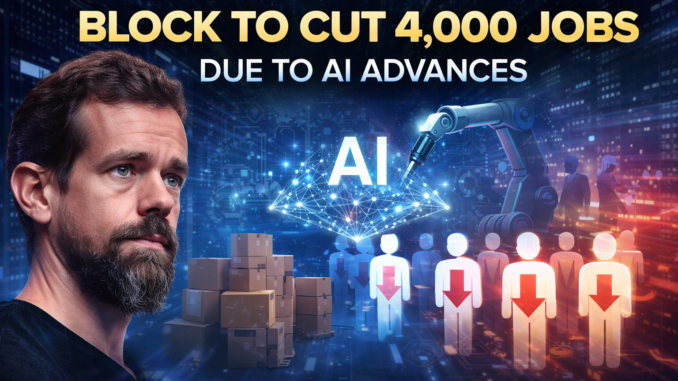
Financial technology company Block, Inc. has announced plans to reduce its workforce by approximately 4,000 employees, citing increased operational efficiency driven by artificial intelligence tools. The decision highlights a growing shift across the fintech industry, where automation and AI systems are transforming how companies manage operations, customer service, and product development.
Block, formerly known as Square, was co-founded by Jack Dorsey, and has been a major player in digital payments, small-business financial tools, and peer-to-peer transactions.
Why the Layoffs Are Happening
According to company statements, AI integration has significantly improved internal productivity. Automated systems are now handling tasks that previously required large teams, including:
Fraud detection and risk analysis
Customer support automation
Code generation and debugging
Financial forecasting and reporting
Marketing campaign optimization
As AI systems become more capable, companies are restructuring teams to focus on higher-level strategy, innovation, and oversight rather than manual processes.
AI’s Expanding Role in Fintech
Artificial intelligence is increasingly central to financial services. From transaction monitoring to predictive analytics, AI allows companies to process vast amounts of data in real time.
Key benefits driving adoption include:
Faster transaction verification
Reduced operational costs
Improved security and fraud prevention
Enhanced personalization for users
Block’s restructuring reflects a broader industry pattern. Many fintech firms are reallocating budgets toward AI infrastructure, cloud computing, and machine learning engineering.
Workforce Impact and Industry Trends
While AI can increase productivity, it also raises important questions about employment and workforce adaptation. Experts note that AI-driven automation does not necessarily eliminate all jobs but often changes skill requirements.
Growing demand areas include:
AI engineers and machine learning specialists
Data analysts and AI ethics professionals
Cloud infrastructure architects
Cybersecurity experts
For professionals in digital marketing, cloud infrastructure, and platform management, understanding AI systems is becoming increasingly valuable in maintaining long-term career stability.
Market Reaction
Technology and financial markets are closely watching how AI adoption affects corporate profitability. Investors often respond positively to cost-cutting strategies tied to automation, especially when companies demonstrate improved margins and efficiency.
However, workforce reductions can also influence public perception and regulatory discussions regarding AI governance and labor transitions.
The Bigger Picture
Block’s announcement illustrates how AI is moving beyond experimentation into core business operations. Across industries—including banking, e-commerce, telecommunications, and media—companies are leveraging AI to streamline processes and reduce costs.
The long-term impact will depend on how businesses balance automation with workforce development and responsible AI practices.
Final Thoughts
Artificial intelligence continues to reshape global industries. Block’s decision to reduce its workforce signals a structural transformation in fintech, where efficiency, automation, and digital intelligence are redefining traditional business models.
As AI tools evolve, companies and professionals alike must adapt to a rapidly changing digital economy.