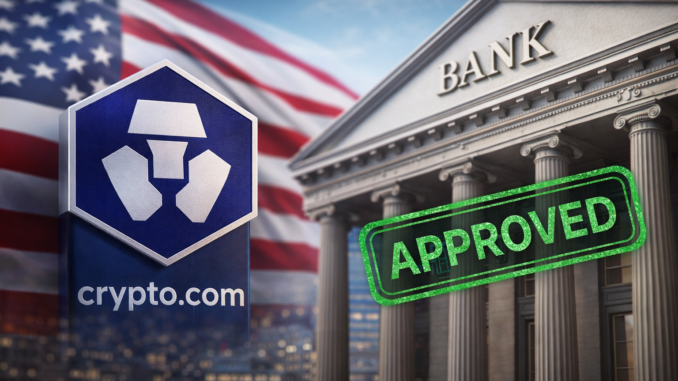
Crypto.com has received conditional approval for a U.S. national trust bank charter, marking a significant step forward for the cryptocurrency exchange’s expansion in the American financial market.
The development highlights the growing intersection between digital assets and traditional financial regulation, as more crypto companies seek structured frameworks to operate within established banking systems.
What Does Conditional Approval Mean?
A national trust bank charter allows a financial institution to provide certain banking and custodial services under federal oversight. However, “conditional approval” means that specific regulatory requirements must still be satisfied before full authorization is granted.
These requirements often include:
Meeting capital and compliance standards
Implementing risk management controls
Completing regulatory examinations
Demonstrating operational readiness
Once finalized, such approval can allow a company to operate trust and custody services nationwide.
Why This Matters for the Crypto Industry
Institutional investors and financial service providers typically prefer regulated frameworks when engaging with digital assets. A trust bank structure may offer:
Federally supervised custody services
Enhanced consumer protection standards
Greater transparency in asset management
Increased credibility within traditional finance
Regulatory milestones like this may encourage broader institutional participation in digital asset markets.
Strengthening Institutional Infrastructure
The cryptocurrency industry has been gradually building infrastructure to align more closely with traditional financial systems. Over the past few years, exchanges and fintech companies have expanded services such as:
Institutional custody solutions
Compliance-focused trading platforms
Stablecoin settlement services
Cross-border payment systems
Moves toward formal regulatory recognition may help bridge the gap between decentralized technology and centralized financial oversight.
Market Reaction and Broader Context
While regulatory approvals often signal long-term strategic positioning, short-term market reactions can vary. Investors typically evaluate how such developments affect competitiveness, compliance costs, and growth potential.
This approval comes at a time when global regulators are working to establish clearer frameworks for digital assets, including stablecoins, exchanges, and custodial services.
The Bigger Picture
The cryptocurrency market continues to mature, with increasing emphasis on regulation, transparency, and institutional integration. Developments such as trust bank approvals reflect how digital asset companies are adapting to operate within established financial systems.
As the industry evolves, regulatory clarity may play a central role in shaping adoption, innovation, and long-term stability.